 Between Stars
Astronomy · Star lore
Animal constellations
The sky is officially divided into 88 constellations. 35 of them show real animals, from a lion and a bull to a giraffe, a toucan and a common fly. Another 7 are mythical beasts such as the dragon, the unicorn and the winged horse. Here is every one of them, and how they got up there.
Between Stars hides 101 animal constellations of its own, which appear as you solve calm star puzzles on iPhone.

All animal constellations
The list follows the 88 constellations recognised by the International Astronomical Union. Two borderline calls are ours: Delphinus counts as a mammal because dolphins are mammals, and Cetus counts as mythical because it was drawn as a sea monster and only later read as a whale. Area is in square degrees; the number after the star name is its apparent magnitude, where lower means brighter.
| Constellation | Animal | Group | Introduced | Brightest star | Area |
|---|---|---|---|---|---|
| Aries | Ram | Mammal | Ancient (Ptolemy) | Hamal 2.00 | 441 |
| Camelopardalis | Giraffe | Mammal | 1612/13 (Plancius) | β Camelopardalis 4.02 | 757 |
| Canes Venatici | Hunting dogs | Mammal | 1690 (Hevelius) | Cor Caroli 2.81 | 465 |
| Canis Major | Great dog | Mammal | Ancient (Ptolemy) | Sirius −1.46 | 380 |
| Canis Minor | Little dog | Mammal | Ancient (Ptolemy) | Procyon 0.34 | 183 |
| Delphinus | Dolphin | Mammal | Ancient (Ptolemy) | Rotanev 3.62 | 189 |
| Equuleus | Pony | Mammal | Ancient (Ptolemy) | Kitalpha 3.92 | 72 |
| Leo | Lion | Mammal | Ancient (Ptolemy) | Regulus 1.35 | 947 |
| Leo Minor | Little lion | Mammal | 1690 (Hevelius) | Praecipua 3.83 | 232 |
| Lepus | Hare | Mammal | Ancient (Ptolemy) | Arneb 2.59 | 290 |
| Lupus | Wolf | Mammal | Ancient (Ptolemy) | Uridim 2.30 | 334 |
| Lynx | Lynx | Mammal | 1690 (Hevelius) | α Lyncis 3.14 | 545 |
| Taurus | Bull | Mammal | Ancient (Ptolemy) | Aldebaran 0.86 | 797 |
| Ursa Major | Great bear | Mammal | Ancient (Ptolemy) | Alioth 1.77 | 1280 |
| Ursa Minor | Little bear | Mammal | Ancient (Ptolemy) | Polaris 1.98 | 256 |
| Vulpecula | Little fox | Mammal | 1690 (Hevelius) | Anser 4.40 | 268 |
| Apus | Bird-of-paradise | Bird | 1598 (Keyser, de Houtman, Plancius) | Paradys 3.83 | 206 |
| Aquila | Eagle | Bird | Ancient (Ptolemy) | Altair 0.76 | 652 |
| Columba | Dove | Bird | 1592 (Plancius) | Phact 2.65 | 270 |
| Corvus | Crow | Bird | Ancient (Ptolemy) | Gienah 2.59 | 184 |
| Cygnus | Swan | Bird | Ancient (Ptolemy) | Deneb 1.25 | 804 |
| Grus | Crane | Bird | 1598 (Keyser, de Houtman, Plancius) | Alnair 1.74 | 366 |
| Pavo | Peacock | Bird | 1598 (Keyser, de Houtman, Plancius) | Peacock 1.94 | 378 |
| Tucana | Toucan | Bird | 1598 (Keyser, de Houtman, Plancius) | Lang-Exster 2.85 | 295 |
| Dorado | Dolphinfish (mahi-mahi) | Fish | 1598 (Keyser, de Houtman, Plancius) | α Doradus 3.26 | 179 |
| Pisces | Two fish | Fish | Ancient (Ptolemy) | Alpherg 3.61 | 889 |
| Piscis Austrinus | Southern fish | Fish | Ancient (Ptolemy) | Fomalhaut 1.16 | 245 |
| Volans | Flying fish | Fish | 1598 (Keyser, de Houtman, Plancius) | γ Volantis 3.61 | 141 |
| Chamaeleon | Chameleon | Reptile | 1598 (Keyser, de Houtman, Plancius) | α Chamaeleontis 4.06 | 132 |
| Hydrus | Little water snake | Reptile | 1598 (Keyser, de Houtman, Plancius) | β Hydri 2.80 | 243 |
| Lacerta | Lizard | Reptile | 1690 (Hevelius) | Stellio 3.76 | 201 |
| Serpens | Snake | Reptile | Ancient (Ptolemy) | Unukalhai 2.62 | 637 |
| Cancer | Crab | Invertebrate | Ancient (Ptolemy) | Tarf 3.52 | 506 |
| Musca | Fly | Invertebrate | 1598 (Keyser, de Houtman, Plancius) | α Muscae 2.69 | 138 |
| Scorpius | Scorpion | Invertebrate | Ancient (Ptolemy) | Antares 0.91 | 497 |
| Capricornus | Sea goat | Mythical | Ancient (Ptolemy) | Deneb Algedi 2.81 | 414 |
| Cetus | Sea monster (later a whale) | Mythical | Ancient (Ptolemy) | Diphda 2.02 | 1231 |
| Draco | Dragon | Mythical | Ancient (Ptolemy) | Eltanin 2.23 | 1083 |
| Hydra | Water serpent | Mythical | Ancient (Ptolemy) | Alphard 2.00 | 1303 |
| Monoceros | Unicorn | Mythical | 1613 (Plancius) | β Monocerotis 3.74 | 482 |
| Pegasus | Winged horse | Mythical | Ancient (Ptolemy) | Enif 2.40 | 1121 |
| Phoenix | Phoenix | Mythical | 1598 (Keyser, de Houtman, Plancius) | Ankaa 2.38 | 469 |
The ancient animals
Most of the familiar animals are very old. In the 2nd century AD the astronomer Ptolemy listed 48 constellations in his Almagest, and 19 of the 35 real animals come from that list, together with five of the mythical beasts: Capricornus, Cetus, Draco, Hydra and Pegasus. Many of these figures are far older than Ptolemy and go back to Greek and Babylonian star lore.
Half of the zodiac is animals: Aries the ram, Taurus the bull, Cancer the crab, Leo the lion, Scorpius the scorpion and Pisces the fish, plus Capricornus, a goat with the tail of a fish.
Birds and fish from a Dutch voyage
The far southern sky cannot be seen from Europe, so the ancient lists left it empty. That changed with the first Dutch voyage to the East Indies, which left Texel on 2 April 1595. Its chief navigator, Pieter Dirkszoon Keyser, had been asked by the cartographer Petrus Plancius to map the southern stars. Keyser died during the voyage in 1596, and Frederick de Houtman returned with the survivors in August 1597.
From their observations Plancius made a celestial globe in late 1597 with twelve new southern constellations. Ten of the twelve are creatures, and they read like a list of exotic animals: the bird-of-paradise (Apus), the chameleon, the dolphinfish (Dorado), the crane (Grus), a small water snake (Hydrus), the fly (Musca), the peacock (Pavo), the toucan (Tucana), the flying fish (Volans) and the phoenix. Plancius added more animals of his own: Columba, first called Noah's Dove, and in 1612 or 1613 the giraffe (Camelopardalis) and the unicorn (Monoceros).
The last animals: Hevelius fills the gaps
The final wave came from Johannes Hevelius, a brewer and astronomer in Danzig. His star atlas Firmamentum Sobiescianum, published by his widow in 1690, filled faint gaps in the northern sky with new figures, five of them animals: the hunting dogs (Canes Venatici), the lizard (Lacerta), the little lion (Leo Minor), the lynx and the little fox (Vulpecula). Hevelius drew the fox with a goose in its jaws. The goose later lost its own constellation, but the fox's brightest star is still called Anser, Latin for goose.
After that, the animals stopped. When Nicolas-Louis de Lacaille mapped the southern sky from the Cape of Good Hope between 1750 and 1754, he filled the remaining gaps with fourteen new constellations, and not one of them is an animal. They are instruments of science and art, such as the telescope, the microscope, the air pump and the pendulum clock, plus Mensa, named after Table Mountain.
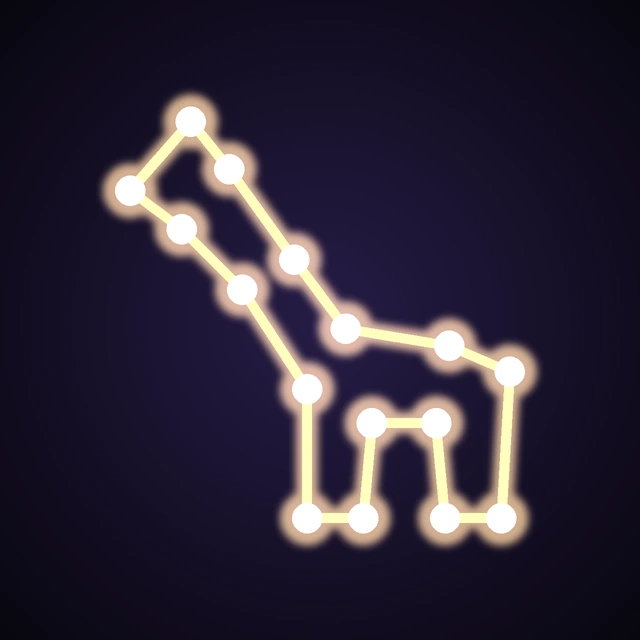
Between Stars invents its own animal sky. Each puzzle is a small star network, and when you solve it the animal it was drawn from appears in gold and takes its place on your sky map. There are 101 of them in seven habitats, from forest to farm, including a giraffe of our own.



Records among the animals
- Largest overall: Hydra, the water serpent, covers 1,303 square degrees and is the largest of all 88 constellations.
- Largest real animal: Ursa Major, the Great Bear, at 1,280 square degrees, the third largest constellation after Hydra and Virgo.
- Smallest: Equuleus, the pony, at 72 square degrees. Only Crux, the Southern Cross, is smaller.
- Brightest star: Sirius in Canis Major, the Great Dog, at magnitude −1.46, the brightest star in the night sky.
- Big but faint: Camelopardalis, the giraffe, covers 757 square degrees, yet its brightest star only reaches magnitude 4. The little fox is fainter still: its brightest star, Anser, is about magnitude 4.4.
- A galaxy inside: Dorado, the dolphinfish, contains most of the Large Magellanic Cloud, a neighbouring galaxy of the Milky Way.
- In two pieces: Serpens, the snake, is split into a head (Serpens Caput) and a tail (Serpens Cauda), held apart by Ophiuchus, the serpent-bearer.
- Pointing north: Polaris, the North Star, is the brightest star of Ursa Minor, the Little Bear.
Animals you can spot tonight
From mid-northern latitudes, a few animal constellations are easy to find without a telescope:
- The Great Bear is up all year. Its seven brightest stars form the Big Dipper, or the Plough, and two of them point to Polaris in the Little Bear.
- The Lion is an evening sight in spring, with bright Regulus at its heart.
- The Swan and the Eagle rule summer evenings. Their brightest stars, Deneb and Altair, make up two corners of the Summer Triangle; the third is Vega in Lyra, the lyre.
- The Scorpion sits low in the south on summer evenings, marked by red Antares.
- The Bull is a winter constellation, with orange Aldebaran and the Pleiades star cluster.
Joining the stars of a constellation into a figure is the same act as the puzzles in Between Stars. If you like the maths behind that, read how one line puzzles work.
Find 101 animals in the stars
Between Stars is a calm puzzle game for iPhone. Guide a glowing aura across star networks, cross every connection or visit every star once, and watch the animal hidden in each level light up in gold. No ads, no timers, and every level is solvable.
Free to download for iPhone with iOS 16 or later. No ads, no subscription.
Questions
How many constellations are animals?
Of the 88 official constellations, 35 show real animals and 7 show mythical creatures such as the dragon, the unicorn and the phoenix. The rest are people, heroes and objects, from Orion the hunter to a telescope and an air pump.
Which constellation is a giraffe?
Camelopardalis. Petrus Plancius introduced it in 1612 or 1613, and its name comes from the Greek word for giraffe, a camel with the spots of a leopard. It is large but faint: its brightest star only reaches magnitude 4.
What is the largest animal constellation?
Hydra, the water serpent, is the largest of all 88 constellations at 1,303 square degrees, but it is a mythical creature. The largest real animal is Ursa Major, the Great Bear, at 1,280 square degrees.
Which zodiac signs are animals?
Six of the twelve: Aries the ram, Taurus the bull, Cancer the crab, Leo the lion, Scorpius the scorpion and Pisces the fish. Capricornus is a seventh if you count the sea goat, a goat with the tail of a fish.
Why does the southern sky have so many exotic animals?
The southern stars were mapped much later than the northern ones. Twelve new constellations came from the first Dutch voyage to the East Indies (1595 to 1597), and Petrus Plancius turned most of them into exotic creatures such as the toucan, the peacock, the chameleon and the flying fish.
Are the animal constellations in Between Stars real?
No. The 101 animal constellations in Between Stars are drawn for the game and are not official constellations. Each one is a star puzzle, and solving it reveals the animal. Some share an animal with the real sky, such as the giraffe, but not their stars.
Sources
- The Constellations – International Astronomical Union
- IAU designated constellations (origin, meaning, brightest star, area) – Wikipedia
- Almagest – Wikipedia
- Pieter Dirkszoon Keyser – Wikipedia
- Camelopardalis – Wikipedia
- Columba – Wikipedia
- Johannes Hevelius – Wikipedia
- Vulpecula – Wikipedia
- Nicolas-Louis de Lacaille – Wikipedia
- Dorado – Wikipedia
- Serpens – Wikipedia
- Sirius – Wikipedia
The grouping into real and mythical animals and the counts per group are our own, based on the meanings in the IAU list.